.svg "Braintrust")

Hire faster with AI recruiting tools
What AI Recruiting tools are available for Hiring?
AI recruiting tools are reshaping how organizations source, screen, and hire candidates. They help teams move beyond manual tasks, reduce bias, and make data-driven hiring decisions in real-time. Let's review the options available, and compare them.














.png?width=106&height=26&name=Vector%20(3).png)





AI recruiting tools are reshaping how organizations source, screen, and hire candidates. They help teams move beyond manual tasks, reduce bias, and make data-driven hiring decisions in real-time.
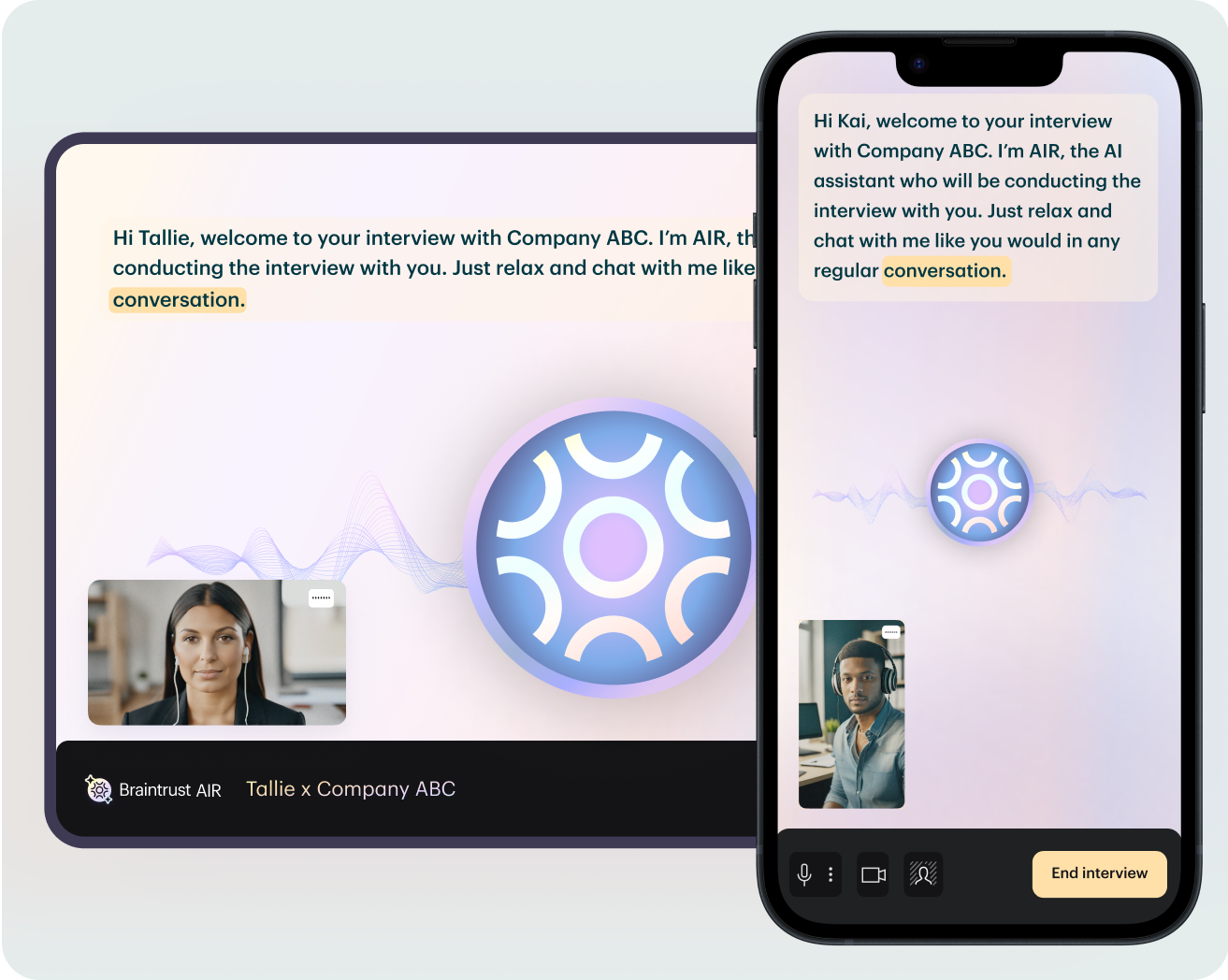
Braintrust AIR leads this transformation by offering a fully automated hiring flow that integrates seamlessly into existing HR systems. With its adaptive AI interviewer and dynamic evaluation scoring, companies report time-to-hire reductions of up to 50% and 10x recruiter productivity.
Other players like Eightfold AI use deep-learning models to match candidates with future roles; HireVue applies video-based AI to assess communication and cognitive skills; and Paradox Olivia automates scheduling and engagement via conversational AI. Yet, Braintrust AIR stands out by combining automation, fairness, transparency, and user ownership — empowering organizations and candidates alike.
What AI Recruiting tools are available and what they can do for your team
Here’s a look at how today’s top AI recruiting tools help modern hiring teams:
| Tool | Core Strength | Ideal For |
|---|---|---|
| Braintrust AIR | End-to-end automation, interview scoring, and skill-based matching | Teams seeking speed, fairness, and quality |
| Eightfold AI | Predictive talent intelligence and internal mobility | Enterprise talent optimization |
| HireVue | AI video interviews and assessment analytics | Volume hiring and skill-based evaluation |
| Paradox Olivia | Conversational AI for scheduling and candidate engagement | High-volume frontline recruitment |
| HiredScore | Ethical AI for inclusive sourcing and bias mitigation | Compliance-driven organizations |
| Humanly | Chat-based candidate screening and DEI analytics | SMBs and mid-sized teams focused on diversity |
What to look for in an AI-powered tool for recruitment
Time & Cost Efficiency
AI Tools should automate sourcing, screening, and evaluation without losing quality.
Fair Access
Every candidate must be evaluated on merit, not personal identifiers.
Consistent Quality
Standardized AI interviews and structured scorecards reduce human bias.
Data Transparency
To understand how AI makes decisions. Trust comes from clarity.
Seamless Integration
The best tools work with your existing ATS and HR systems.
Compliance
AI hiring tools meet the highest standards in data protection and AI transparency.
Meet Braintrust AIR: Your Complete AI Hiring Platform

Tailor your hiring workflow with AI that works the way you do. Braintrust AIR optimizes processes for teams hiring at scale, in technical domains, or with fluctuating demand.

How to choose an AI Hiring Software

What compliance and regulatory issues should I check when evaluating an AI hiring tool?
When choosing an AI hiring solution, it’s important to verify that the tool supports compliance with relevant laws and regulations. That includes anti-discrimination laws (e.g., the U.S. Equal Employment Opportunity Commission (EEOC) guidance, or state-level laws such as NYC Local Law 144) which require employers to assess disparate impacts of “automated employment decision tools”.
You’ll also want to check data privacy and consent frameworks (for example how candidate data is stored, processed, used). A good vendor should provide documentation of auditability, transparency of the algorithms, bias-mitigation protocols, and compliance with industry standards.
How do I assess bias risk and fairness in an AI hiring platform?
Bias risk arises if the tool’s training data, decision-logic or processing mechanisms favor certain groups. Best practices: ensure the vendor uses diverse training data, employs methods like blind screening or anonymization of identifiers, provides explainability of scores, and supports regular audits (pre-, in-, post-processing) of fairness. Make sure the tool allows you to monitor outcomes by demographic slices (or at least by function/role) and can provide transparency on how candidate ranking or scoring is done.
How important is ease of use and adoption for recruiters and hiring managers?
Very important. Even the best AI tools fail if adoption is low because users find them too complex, or they break existing workflows. You should evaluate vendor UI/UX, training requirements, recruiter/admin dashboards, candidate experience, and whether the tool integrates smoothly into your hiring team’s daily workflow. Also check for setup time, configuration complexity, and whether non-technical staff can manage the tool or whether you’ll need specialist resources.
What level of human oversight or management should be retained when using AI hiring tools?
Even advanced tools must incorporate human judgment and oversight. AI should support decision-making, not completely replace it. Human recruiters should review AI-generated shortlists, ensure fairness/contextuality, tune scoring criteria, and handle exceptions. Tools that require “set-and-forget” with no human in the loop risk poor decisions and higher bias risk. When evaluating a vendor, ask how they enable human review, how transparent their scoring is, and how you can override or audit decisions.
How complex is the implementation and integration with existing systems (ATS, HRIS, etc.)?
Integration matters a lot. Your AI hiring tool will be more effective if it communicates with your existing Applicant Tracking System (ATS), HRIS, CRM, video-interview platform, etc. Ask about native integrations, API access, data flow, synchronization, security, and maintenance overhead. Also evaluate whether the tool can be configured to match your existing hiring stages, workflows, templates and reporting.
Is the tool truly end-to-end (covering sourcing, screening, interviewing, matching, onboarding) or only partial?
A key decision: Do you need a full funnel solution or only a point-solution (e.g., screening or video interviewing)? For example, some tools specialize in video-based assessment only (e.g., HireVue). If you want a unified workflow from job posting to hire, an end-to-end solution may simplify vendor management, data consistency, and analytics. But if you already have parts of the process covered (e.g., sourcing & ATS), a best-of-breed component may suffice.
What industries or verticals is the tool suited for?
Different sectors have different needs (e.g., high-volume hourly/front-line hires vs. highly-skilled professional roles). You should check vendor track record in your vertical (e.g., healthcare, retail, tech, manufacturing). Does the tool support specific competencies, job families, geographic/regulatory constraints (e.g., EU, US, LatAm)? Vendor case studies or references in your target vertical are helpful.
What results or ROI can be expected—and how will success be measured?
Ask for metrics: time-to-hire reduction, cost per hire, quality of hire (e.g., retention, performance), diversity outcomes, candidate experience metrics. Also check for vendor transparency on those metrics, how they were measured, and whether you can expect similar outcomes given your context. Be clear on baseline metrics, target improvements, and how to attribute gains to the tool versus process improvements.
What support, training, and change-management are provided by the vendor?
New tools require adoption, training sessions, onboarding of users (recruiters, hiring managers), alignment of job descriptions, assessment criteria, workflows. Ask about vendor training programs, customer success management, templates, best-practices, and ongoing support. A strong vendor partnership can accelerate adoption and outcomes.
How does data ownership, privacy, and vendor transparency work?
Important to clarify who owns the candidate / hiring data, how it’s stored, audited, shared, and whether vendor uses the data for its own analytics (and if so, how consent is handled). Confirm compliance with GDPR, CCPA, or local data-protection laws as applicable. Also check for vendor transparency: Can you get access to audit logs, scoring methodologies, model performance and biases? This is especially important to maintain employer accountability if regulators query your process.
Braintrust AIR, your new automated hiring engine
Connect your ATS
Braintrust AIR instantly scans your existing applicants, no sourcing required.
Interview automatically
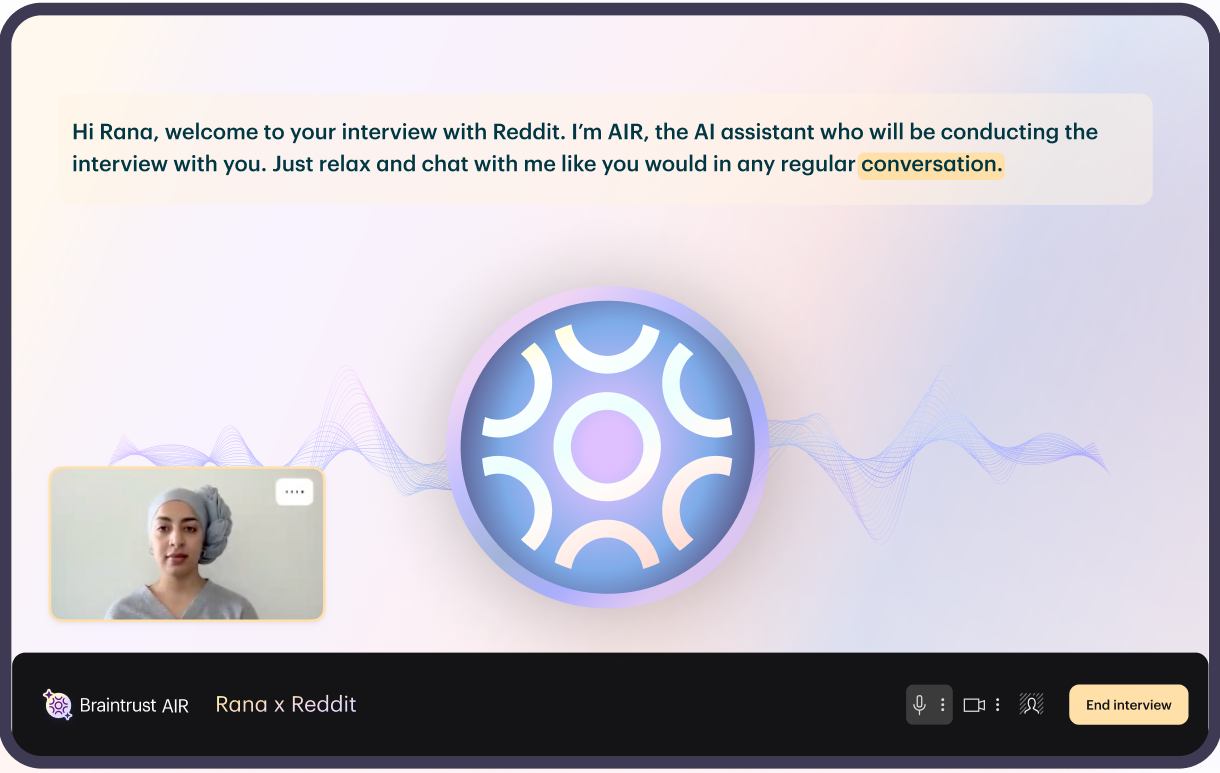
Every qualified candidate completes an AI-led video interview.
Score instantly
Braintrust AIR evaluates responses on communication, problem-solving, and technical fit, fully customizable to your scoring rubrics.
Review and advance
Recruiters receive structured scorecards and candidate videos to move the best forward, fast.

Frequently Asked Questions
Will an AI hiring tool replace our recruiters completely?
No. AI tools are designed to augment recruiters, not replace them. They automate repetitive tasks (sourcing, screening, matching, initial assessment), freeing recruiters to focus on higher-value work (engaging candidates, decision-making, culture fit, negotiation). Human judgement remains essential—especially for complex roles, candidate experience, emotional intelligence. A well-designed tool will include human-in-the-loop reviews, and allow flexibility for recruiters to intervene.
How much time and cost savings can we realistically expect?
It depends on volume, role complexity, current process efficiency, and tool adoption. Some vendors claim up to 50% reduction in time-to-hire or 10× recruiter productivity. But you should treat these as upper bounds. To estimate ROI: measure your current cycle times, cost/hire, screening ratios, etc., then model improvement with automation. Also factor in upfront training, configuration, change-management costs. The key is realistic baselining and measurement.
How do we guard against bias when using an AI tool?
Key steps: Choose a vendor with transparent algorithms and fairness governance. Ensure training data is representative of your candidate population. Remove or anonymize demographic identifiers where possible (names, photos, schools). Implement human review of AI-generated decisions. Regularly audit outcomes (shortlists, hiring, diversity results). Create aligning policies (for example candidate feedback channels, bias escalation process). This helps you reduce both legal risk and reputational risk.
Do we still need to involve human reviewers or managers if we use AI hiring tools?
Yes, definitely. AI should support human reviewers—not replace them. Human involvement remains important for final decisions, contextual judgement, candidate experience, culture fit and managing exceptions. Also, human oversight is often a requirement for legal and ethical compliance. A practical process: AI ranks or filters, human recruiter reviews shortlists, interviewer engages, final hiring manager decision.
Can the tool integrate with our existing ATS/HRIS/CRM systems?
Ideally yes. A good AI hiring solution will either natively integrate with your ATS/HRIS (or other workflow tools) or provide API/connector support. This makes data flow smoother, reduces manual transfers, supports analytics, and enhances user adoption. When evaluating, ask for a list of existing integrations, reference implementations, and data-security architecture.
What kinds of roles or hiring volumes are AI tools best suited for?
AI hiring tools can support a wide range of roles—from high-volume front-line hires (retail, service, call-center) to professional/technical roles (engineering, sales). High-volume roles benefit most from automation of sourcing, screening, and interviewing. For technical or niche roles, AI may focus more on skill‐matching, candidate-job fit, assessment of competencies. Evaluate whether the tool supports your role types/volume and whether vendor has experience in your sector.
What’s the typical setup time and learning curve for recruiters and hiring teams?
Setup can vary: from a few weeks for basic configurations to several months for full enterprise rollout. It depends on number of roles, templates, data migration, integrations, training, and process alignment. Look for vendors with accelerators/templates, onboarding programs, and support for change management. Monitor adoption metrics early to ensure ROI.
How do we measure the success of our AI hiring tool implementation?
Key metrics include:
- Time-to-hire (or time-to-fill)
- Cost-per-hire
- Number of interviews per hire
- Quality-of-hire (e.g., performance/retention of hires)
- Diversity & inclusion outcomes (hired candidate mix vs. benchmarks)
- Recruiter productivity (e.g., number of hires per recruiter)
- Candidate experience metrics (application completion rate, candidate NPS)
-
System adoption and funnel conversion improvements
Define baseline metrics before implementation, set target improvements, and track ongoing.
Are there any legal or ethical risks associated with AI recruiting tools?
Yes. Risks include potential discriminatory outcomes (if the algorithm favors certain groups), data-privacy or consent violations, lack of transparency (making it hard to explain decisions), and vendor liability. For example, algorithmic bias can lead to disparate impact under anti-discrimination laws. Mitigation: choose vendors with robust governance, maintain human oversight, conduct audits, document vendor controls, and ensure candidate communication is clear about AI usage.
What role does candidate experience play when using AI in hiring?
Candidate experience remains critical. Even if you automate large parts of the process, you must ensure candidates aren’t left in “black-box” processes, feel ignored, or receive unfair treatment. Provide visibility (e.g., AI interviews vs. human next steps), clear communications, opportunities for feedback, and fairness. Better candidate experience helps your employer brand, improves acceptance rates, and supports diversity goals. The AI tool you choose should support transparency and a smooth candidate journey.
Automate At Scale, Unlock Human Potential
with Braintrust
.png)

Start using Braintrust AIR to accelerate your Hiring process. Get started for free today.



.png)