
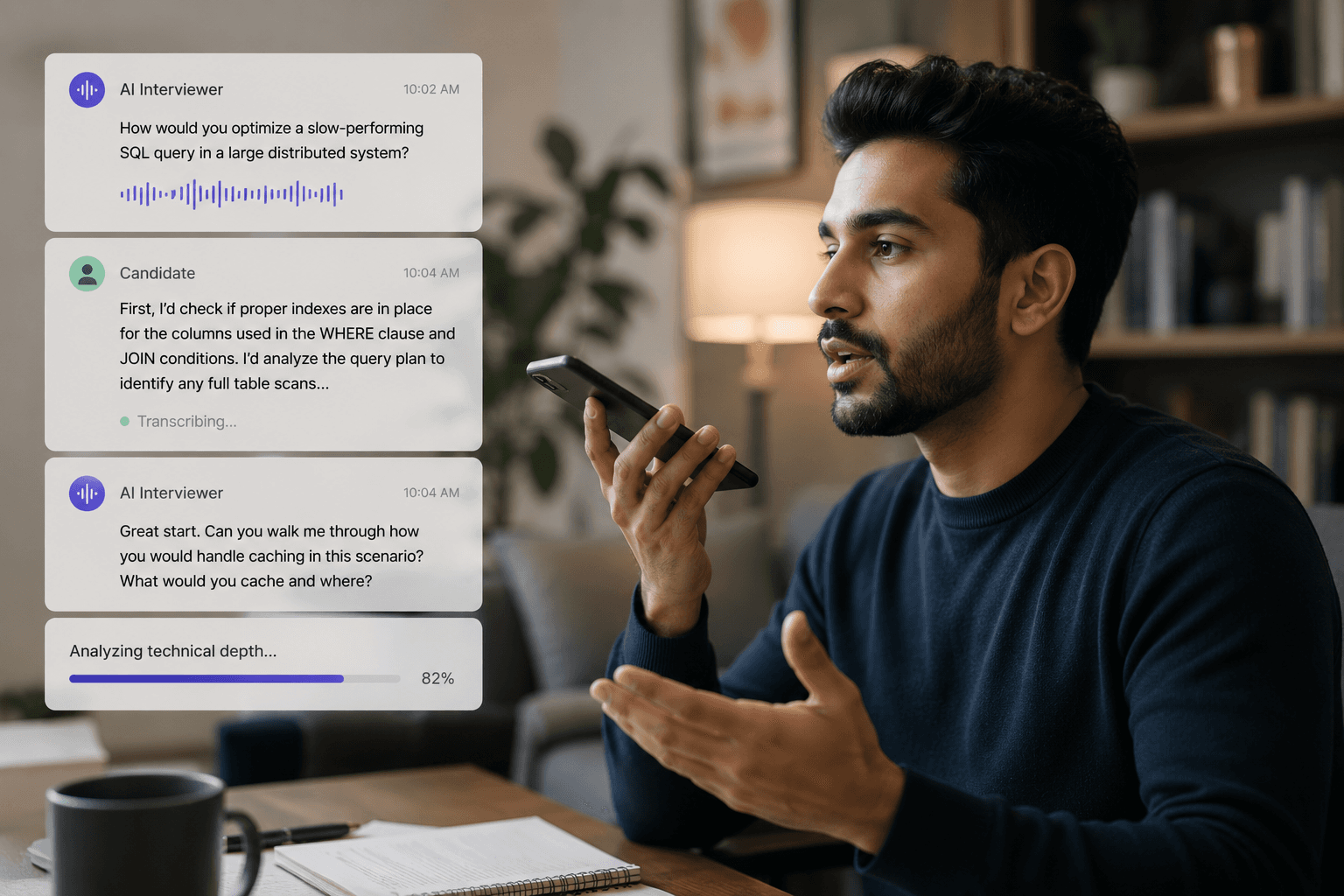
For technical recruiting teams, assessing engineering talent is a notoriously expensive bottleneck. Engineering managers get pulled away from product development to conduct 45-minute technical phone screens, many of which end in a quick rejection. Earlier attempts to automate this, through coding tests and algorithmic puzzles, proved deeply flawed, testing rote memorization rather than real engineering capability.
AI tools that assess coding and technical skills fall into eight categories, and they measure different things. Choosing between them is not a brand decision. It is a decision about which signal you need, at which stage, at what cost per candidate, and with what defense against AI-assisted answers.
The short answer
- Eight categories, not one market. Live collaborative coding, async auto-scored tests, conversational AI technical interviews, async video with AI scoring, job-replica simulations, interview intelligence, proctoring and integrity layers, and broad skills suites.
- Structure beats format. Structured evaluation carries an operational validity of .42, against .19 for unstructured interviews. That gap is larger than any difference between vendors.
- Integrity is now the deciding criterion. With 84 percent of developers using or planning to use AI tools, an unproctored take-home measures tool access as much as skill.
- The whiteboard is the weakest option. In a controlled study of 48 developers, 61.5 percent failed the task when an interviewer watched, against 36.3 percent who failed working privately.
The eight categories of AI technical assessment
Scroll to see all columns
| Category | What it measures | Best for | Main failure mode |
|---|---|---|---|
| Live collaborative coding | Working code written under observation, with an interviewer present | Final-round depth, pairing signal | Consumes engineer time for every candidate, so it cannot run at the top of the funnel |
| Async auto-scored coding tests | Correctness against hidden test cases | Volume filtering on well-defined skills | Measures puzzle familiarity and tool access, and drives candidate drop-off |
| Conversational AI technical interviews | Reasoning, architecture choices, and trade-off judgment, in the candidate's own words | First-round screening at volume | Rewards articulate explanation, so it needs pairing with an artifact for hands-on roles |
| Async video with AI scoring | Recorded answers scored against a rubric | Structured comparison across many candidates | One-way formats are unpopular and produce no follow-up depth |
| Job-replica simulations | Performance on a task close to the real work | Predictive validity on hands-on roles | Typically several hours of candidate time, which limits completion |
| Interview intelligence | Nothing. It records, transcribes, and analyzes human interviews | Interviewer calibration and debriefs | Often mistaken for an assessment tool when it scores no one |
| Proctoring and integrity | Identity, environment, and evidence of outside assistance | Regulated or high-stakes hiring | False positives carry a real cost to candidates and to brand |
| Broad skills suites | A wide library of role tests, technical and non-technical | Mixed hiring across many job families | Breadth over depth on senior engineering signal |
Scroll to see all columns
Most teams need two of these, not one. A conversational or simulation-based first round to decide who is worth an engineer's time, then live coding for the people who clear it.
How to choose a technical assessment tool
Choose a technical assessment tool by starting from the signal you need, then working backwards to the format that produces it at your volume.
Scroll to see all columns
| Criterion | Question to ask | Why it decides the outcome |
|---|---|---|
| Signal type | Do you need working code, or reasoning about systems | A senior backend hire fails or passes on architecture judgment, not on syntax |
| Stage cost | What does one assessment cost in engineer hours | Anything requiring a human interviewer cannot be the first filter |
| Candidate time | How long is the assessment | Completion falls sharply as required time rises, and drop-off is a hidden selection effect |
| Integrity model | How does the tool handle AI-assisted answers | An unproctored, auto-scored test measures tool access alongside skill |
| Score transparency | Does each score link to the evidence that produced it | An unexplainable score cannot be reviewed, defended, or audited |
| Adaptivity | Does the system ask a follow-up based on what the candidate said | Follow-up questions separate practitioners from people repeating terminology |
| ATS integration | Do scores and recordings write back to the candidate record | Otherwise the signal lives in a tool nobody opens |
| Compliance posture | SOC 2, bias audit, notice obligations, accommodation path | Employment assessment is regulated, and enterprise procurement will ask |
Scroll to see all columns
AI-assisted cheating and the integrity problem
AI-assisted cheating is now the central integrity problem in technical screening, and it has quietly invalidated the format most teams still rely on.
The Stack Overflow Developer Survey, covering 49,000 respondents across 177 countries, found 84 percent of developers using or planning to use AI tools, up from 76 percent the previous year. Google Cloud's DORA research reports 90 percent of software professionals using AI at work, at a median of two hours a day. On the candidate side, Gartner found 39 percent of applicants used AI during the application process and 6 percent admitted to interview fraud.
An unproctored algorithmic test in that environment measures whether the candidate used a model, not whether they can build. There are three responses, and only two of them work:
- Proctor the artifact. Identity checks, environment monitoring, and AI-generation detection. This raises friction and produces false positives that fall unevenly.
- Change the question. Ask about decisions the candidate actually made, then probe the specifics with follow-up questions. A model can produce a correct answer. It cannot produce the candidate's memory of why their team chose read replicas over sharding in 2023.
- Ignore it. Which is where most funnels currently sit.
The second option is the one that scales, because it does not fight the tool. It asks a question the tool cannot answer for you.
"AIR never auto-accepts or rejects candidates. Recruiters review scorecards and video before decisions," per Braintrust's published AI hiring compliance documentation.
How AI evaluates a technical answer
Modern conversational AI interview tools are not keyword matching engines. They use large language models to reach semantic understanding of technical concepts, which is what makes them usable on open-ended engineering questions.
When an AI interviewer assesses a software engineer, it is not listening for the word "React" or "Kubernetes." It parses the structure of the explanation. Asked how to optimize a slow query in a large distributed system, it evaluates whether the answer reaches indexing, partitioning, read replicas, or caching layers, and whether the candidate explains the trade-offs between them.
The natural language processing layer maps the transcribed response against a matrix of technical relationships. It understands that Redis is functionally related to caching, and that B-trees relate to database indexing. That is what lets the system score depth accurately when a candidate uses different terminology or comes at the problem from an unexpected angle.
Adaptive follow-up is the part that matters
If a candidate mentions migrating a monolith to microservices, the system generates a contextual follow-up. How did you handle distributed transactions, and how did you keep data consistent during the migration. That question separates buzzword recall from practitioner experience. A junior developer who memorised the terms stalls. A senior engineer moves straight into saga patterns or two-phase commits.
This is also the integrity mechanism. A scripted or model-generated answer survives the first question and rarely survives the third. More on the mechanics in our write-up of adaptive interviewing and the engineering behind conversational AI interviews.
What the evidence says about technical interview formats
Format choice is usually argued from taste. There is enough published research to argue it from evidence.
Scroll to see all columns
| Finding | Figure | Source |
|---|---|---|
| Structured interviews predict performance far better than unstructured ones | Operational validity .42 against .19, with work samples at .33 and cognitive ability at .31 | Sackett et al., Industrial and Organizational Psychology, 2023 |
| Being watched while coding changes the result | 61.5 percent failed in the observed condition against 36.3 percent in private, with a median of 1 test case passed against 3 | Behroozi et al., ACM ESEC/FSE 2020 |
| A bad interview process costs you future applicants | An analysis of more than 10,000 interview reviews across 19 companies documented systematic candidate frustration, and the same paper cites survey work finding negative hiring-process reviews demotivate more than 55 percent of job seekers | Behroozi et al., ICSE-SEIS 2020 |
| Developers do not trust AI output, and neither should your rubric | 46 percent actively distrust AI accuracy against 33 percent who trust it; 66 percent cite answers that are almost right; 45 percent say debugging AI code takes longer | Stack Overflow Developer Survey 2025 |
| The candidate pool is large and growing | 180 million developers on GitHub, with 36 million joining in twelve months | GitHub Octoverse 2025 |
| Hiring volume is steady, so screening cost compounds | About 106,100 US software developer, QA, and tester openings a year, on 10 percent projected growth | US Bureau of Labor Statistics |
| Candidates do not assume AI evaluation is fair | 26 percent of applicants trust AI to evaluate them fairly | Gartner, 2025 |
Scroll to see all columns
The whiteboard finding deserves a second read. Forty-eight developers were split across the two conditions and given the same problem. The only variable was whether someone watched. That is a measurement instrument reporting on the interviewer, not on the engineer.
Compliance and security in technical assessment
Technical assessment tools sit inside employment law, and enterprise security review will ask about both.
- Adverse impact. Selection rates below 80 percent of the highest-scoring group's rate trigger scrutiny under the Uniform Guidelines, whoever built the tool.
- Bias audit and notice. NYC Local Law 144 requires an independent annual audit and 10 business days' candidate notice for automated employment decision tools.
- High-risk classification. The EU AI Act classifies candidate evaluation systems as high risk under Annex III.
- Accommodation. Under 29 CFR 1630.11, a test must measure the skill rather than an impairment, which affects timed and proctored formats directly.
- Security review. Expect questions on SOC 2 Type II, data residency, retention, and whether candidate data trains the vendor's models.
Braintrust publishes its bias audit results and governance posture for this reason. Ask every vendor on your shortlist for the same artifacts.
Where conversational AI interviews fit
Conversational AI interviews are a first-round instrument. They are strong on reasoning, trade-off judgment, and communication, and they run at a marginal cost that makes it practical to interview every applicant rather than the first fifty. They are weaker as a sole signal for hands-on implementation roles, where an artifact still matters.
The sensible architecture for most engineering funnels is straightforward. Use a conversational technical interview to decide who is worth engineer time. Use live coding or a job-replica task for the people who clear that bar. Keep the artifact stage small enough that senior engineers will actually staff it.
Teams comparing named products across the wider market can start with our rundown of AI interview software, and our take on why one-way video formats underperform. To test the depth of the technical questioning directly, run a live interview with AIR and try to stump it on architecture, or book a demo.
Frequently Asked Questions
Which AI tools assess coding and technical skills during interviews
They fall into eight categories: live collaborative coding, async auto-scored coding tests, conversational AI technical interviews, async video with AI scoring, job-replica simulations, interview intelligence, proctoring and integrity layers, and broad skills suites. Match the category to the signal you need before comparing individual products.
What is the difference between a coding assessment and an AI technical interview
A coding assessment produces an artifact scored against test cases. An AI technical interview produces a conversation scored against a rubric, including reasoning and trade-offs that a passing test suite does not reveal. Most mature funnels use both, at different stages.
How do technical screening tools prevent AI-assisted cheating
Through proctoring, through AI-generation detection, or by changing the question so outside help does not help. Adaptive follow-up questions about a candidate's own decisions are the most durable defense, because a model cannot supply the candidate's specific project history.
Are coding tests better than live technical interviews
Neither format wins on its own. Structure is what predicts performance, at an operational validity of .42 against .19 for unstructured interviews. A structured conversation outperforms an unstructured live session, and a well-designed work sample outperforms an algorithm puzzle.
How long should a technical assessment take
Short enough that qualified candidates finish it. Completion rate falls as required time rises, and every candidate who abandons is a silent selection decision made by your process rather than by your rubric.
Can AI accurately evaluate a senior engineer
On architecture, trade-offs, and system design reasoning, yes, provided the system asks adaptive follow-up questions rather than reading from a fixed script. On hands-on implementation quality, pair it with a code artifact.
Do AI technical interviews replace engineering interviewers
No. They replace the first-round phone screen that engineers dislike staffing, and return a ranked shortlist with transcripts and evidence. Final rounds, design discussion, and the hiring decision stay with the team.
What should a technical assessment report include
A per-criterion score, the specific response text that produced each score, the full transcript or recording, and a clear statement of what was not assessed. A single composite number with no trace is not reviewable.
Is AI technical screening compliant with hiring law
It is regulated rather than exempt. Expect adverse impact obligations under the Uniform Guidelines, bias audit and notice duties under NYC Local Law 144, high-risk classification under the EU AI Act, and accommodation duties under the Americans with Disabilities Act.