If you're on the job market right now, there's a real chance your next first-round interview won't be with a human recruiter. Over the last 18 months, a growing number of enterprise organizations have adopted AI video interviews to handle first-round assessments. For candidates used to traditional interviews, talking to an AI on video can feel unfamiliar at first.
Here's the thing: understanding how these tools work is the key to doing well in them. And the good news is that when you interact with a well-designed system, the AI is actually much fairer and more objective than a human screen.
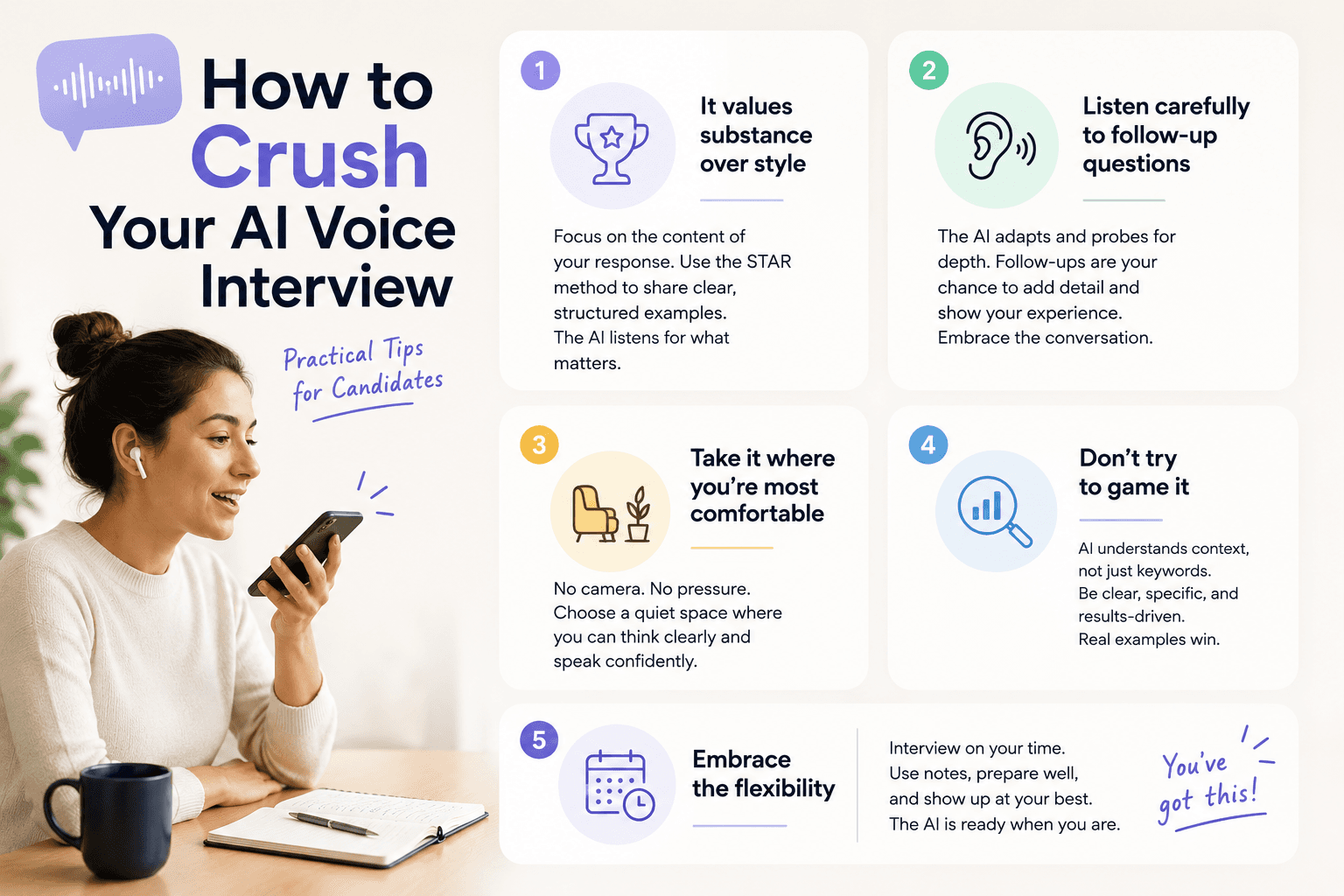
It values substance over style
When a human interviews you, they're often subconsciously swayed by charisma, your background setting if it's on video, or how smoothly you speak. AI voice assessment doesn't care about any of that. The AI transcribes your audio and evaluates the text of your answer. It's specifically looking for you to demonstrate the core competencies of the job. Focus entirely on the content of your response. The STAR method — Situation, Task, Action, Result — works particularly well here. If you pause, take a breath, or collect your thoughts, the AI patiently waits.
Listen carefully to follow-up questions
The defining feature of modern AI assistants is adaptability. They're not reading a script. If you provide a brief or generic answer, the AI will likely ask a contextual follow-up to draw you out. "Can you provide a more specific example of how you resolved the data conflict?" isn't a trick — it's the AI giving you a second chance to provide the behavioral evidence its rubric is looking for. Treat it exactly like a thoughtful manager probing for depth.
Lean into the conversation
One of the biggest advantages of a live AI video interview is that it's a real conversation. Unlike a one-way recorded platform where you're performing to a blank screen, AIR engages with you — the AI responds, asks follow-ups, and gives you natural openings to expand on your answers. Treat it like you'd treat a call with a thoughtful hiring manager: be present, speak clearly, and let the natural back-and-forth guide you.
Don't try to game it
It's a common misconception that dropping enough buzzwords from the job description will fool the AI. It won't. These platforms use semantic scoring, which means they understand context. "I managed the synergistic KPI roadmap leveraging agile blockchain methodologies" scores much lower than "I created a dashboard that tracked our weekly sprint progress, resulting in a 15% faster release cycle." Clear, specific accomplishments always win.
Embrace the flexibility
The AI doesn't have a calendar. If the company sends you an interview link, you can take it at 11 PM on a Tuesday. Use notes (no one can see you referencing them), prepare thoughtfully, and start when you're at your peak. If you want to experience what these feels like without the pressure, try AIR for yourself and go through a mock interview before your real one.