
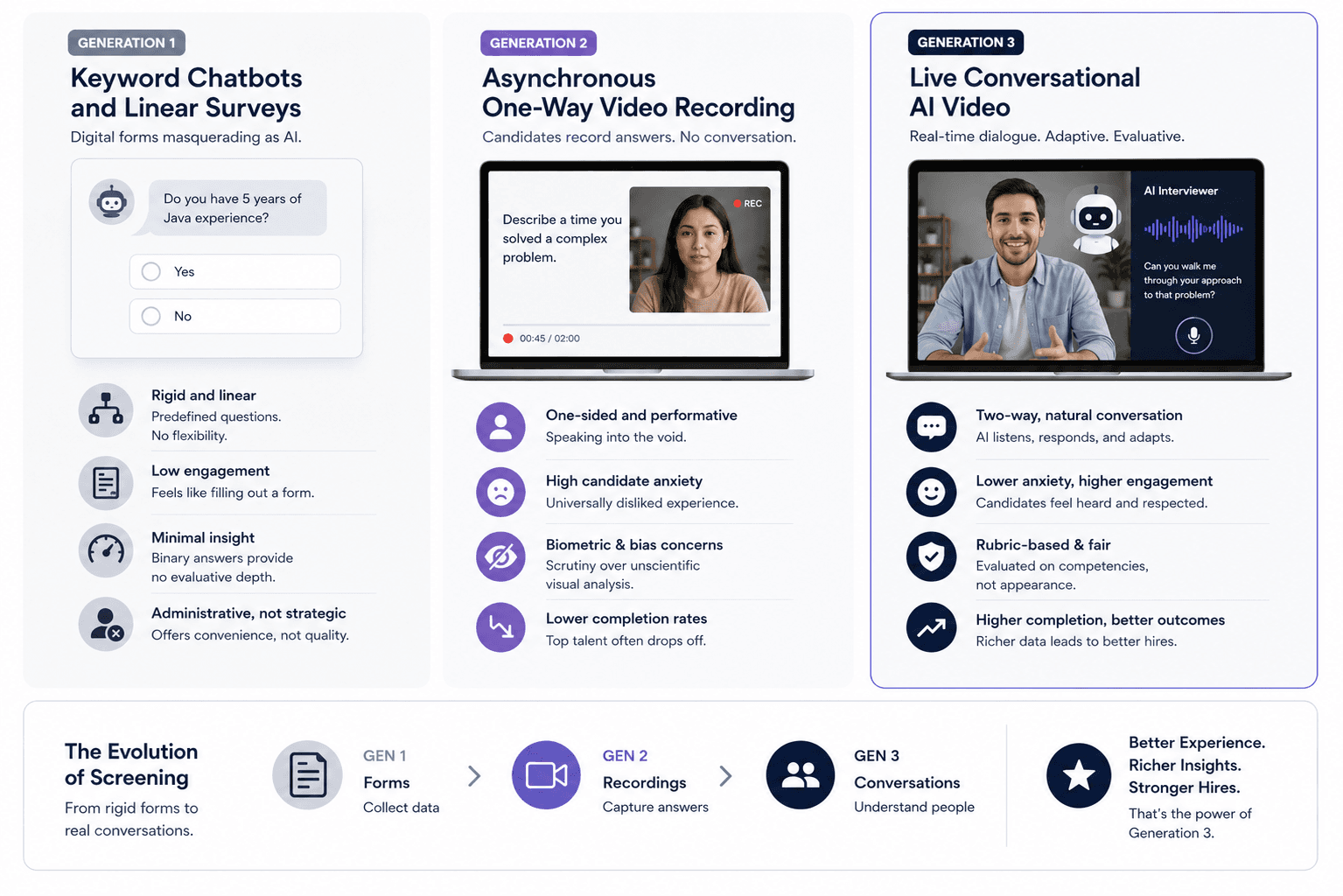
The discussion around talent acquisition technology has shifted from "Should we use AI?" to "Which AI architecture is right for us?" The market is notoriously crowded, with hundreds of vendors claiming algorithmic advantage. Navigating it requires understanding the underlying architectures that separate genuinely transformative tools from glorified form automation.
At a macro level, the market divides into three distinct generations of screening technology.
Generation 1: Keyword Chatbots and Linear Surveys
These tools dominated the late 2010s. Found on career pages and ATS portals, they asked candidates rigid multiple-choice questions or prompted them to input basic text — "Do you have 5 years of Java experience? Yes/No." They're essentially digital forms masquerading as AI. While they offer minor administrative automation, they provide zero evaluative depth and annoy candidates who quickly recognize they're talking to a rigid decision tree.
Generation 2: Asynchronous One-Way Video Recording
Driven by demand to automate phone screens during the remote work era, many companies adopted platforms requiring candidates to upload recorded video answers. The candidate speaks into the void, answering text on a screen with no one listening. Some platforms controversially claimed to analyze micro-expressions or sentiment. Candidates universally dislike these tools due to their performative, one-sided dynamic — and state and local legislators are increasingly scrutinizing platforms that use unscientific visual biometric analysis.
Generation 3: Live Conversational AI Video
The true frontier is fully conversational, live AI video. Utilizing large language models and real-time video infrastructure, these platforms conduct genuine two-way interviews. A digital assistant appears on screen, engages in real-time dialogue, evaluates responses for semantic meaning, and generates contextual follow-up questions dynamically.
Braintrust AIR is built on this architecture. Unlike Generation 2's passive recording, AIR conducts a live conversation — the AI is present, listening, and responding. Candidates feel heard. Hiring managers get video recordings alongside structured scorecards. And every decision is graded against a documented rubric, not an opaque algorithm.
For enterprise buyers, the decision matrix should heavily weight both candidate experience and assessment richness. Generation 3 tools are the only ones that deliver a genuine, conversational interaction while also giving hiring managers the full picture — what the candidate said and how they showed up.
When comparing vendors, treat live adaptive conversation with rubric-based scoring as the baseline requirement. Any tool still relying on one-way recording or rigid decision trees is already behind. Try AIR for yourself or book a demo to experience the difference firsthand.