For decades, the standard job interview process has implicitly favored a very specific type of candidate: the charismatic extrovert who thrives under the intense, performative spotlight of an executive conference room. While charisma matters for some roles, for the vast majority of technical, operational, and support positions, assessing a candidate based on their polish in front of a panel isn't just irrelevant — it's exclusionary.
This systemic exclusion reached its peak with asynchronous one-way video interviews. By forcing candidates to record video answers to a blank screen, companies unintentionally built massive barriers for neurodivergent candidates, individuals with severe anxiety, and applicants who weren't sure how to "perform" for a camera with no feedback.
Live AI video interviewing is rapidly reversing this trend — not by removing video, but by restoring conversation.
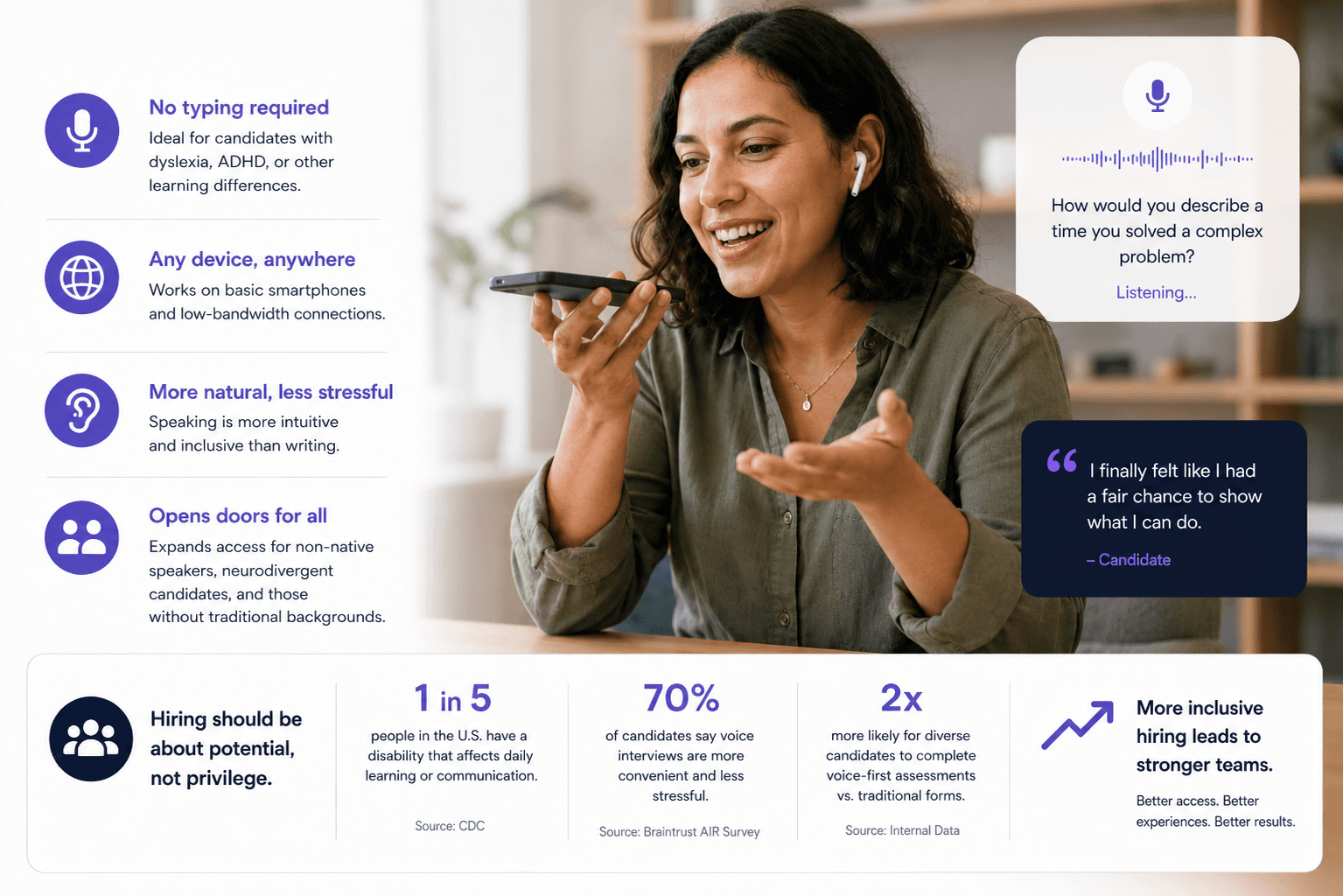
When a candidate interviews with Braintrust AIR, they're not recording a monologue. They're having a real, live, adaptive conversation. The AI listens, responds, and follows up. Because the dynamic is genuinely conversational rather than performative, the anxiety that plagues one-way recording melts away. Candidates can focus entirely on demonstrating their actual skills.
This has profound implications for neurodivergent candidates, particularly those on the autism spectrum, who frequently report that the one-way recording format — performing to a blank camera, no feedback, no natural rhythm — completely derails their ability to demonstrate technical competencies. A live conversational AI creates a natural, responsive dynamic that much more closely resembles how they actually communicate with colleagues.
A conversational AI assistant is also genuinely patient. If a candidate is nervous, needs 15 seconds to think, or wants to self-correct after a stumble, the AI holds the space without rushing them. Unlike a recruiter looking at their next calendar appointment, the AI isn't watching the clock.
Critically, every candidate is evaluated against the exact same rubric. The AI doesn't score based on how polished someone looks, whether their lighting is flattering, or how naturally they perform to a camera. It evaluates whether they demonstrated the required competencies. That structural fairness is what makes live AI video genuinely inclusive — it captures the richness of video while eliminating the subjectivity that has historically made video interviews unfair.
If your organization is committed to genuinely equitable hiring, replacing passive one-way recording with live AI conversation is one of the highest-impact changes you can make. Book a demo to review our accessibility architecture, or try AIR for yourself and see what an inclusive candidate experience actually feels like.