Three distinct formats dominate AI-powered interview screening today: conversational voice interviews, live AI video conversations, and one-way recorded video submissions. Each solves a different hiring problem. The split that matters most for candidate experience is whether the interview is a real two-way conversation or a recorded monologue.
Braintrust AIR is conversational voice interview software: a two-way, adaptive voice screen with follow-up questions that change based on what the candidate says, then a ranked evidence pack for a human reviewer. That is a different product from one-way recorded video tools. AIR is not positioned as live video as the primary format.
Conversational voice: two-way adaptive interviews (not one-way recorded video)
If the goal is a genuine back-and-forth conversation rather than a recorded monologue, several platforms are built around live voice:
- Braintrust AIR: real-time adaptive conversational voice interviews with role-specific rubric scoring, ATS-synced rank lists, and human-in-the-loop review. Recruiters decide who advances. Try a live demo, review volume-based pricing, or read how AIR stays compliant.
- HeyMilo: real-time adaptive voice interviews conducted by phone or web audio, with follow-up questions generated based on candidate responses. Built for high-volume screening across multiple languages.
- Paradox (Olivia): conversational AI that engages candidates via voice and chat, most established in high-volume frontline and hourly hiring, though enterprise implementation costs put it out of reach for smaller teams.
- InterviewFlowAI: phone-first AI interviews with adaptive follow-up questions, positioned around higher completion rates than video for candidate pools without reliable camera access; the vendor cites phone completion rates above 80% versus 40-60% for video, though that figure comes from the vendor's own published comparison and should be treated as a vendor claim, not an independently verified benchmark.
- Classet: phone-based AI screening built specifically for frontline, hourly hiring (retail, hospitality, healthcare), where camera-based tools create friction for candidates applying from a phone.
These tools solve a real, specific problem: candidates who don't have reliable camera access, don't want to be on video, or are applying from a phone in a public or shared space. Conversational voice removes that barrier while still running a two-way screen.
When a candidate connects with AIR, the AI speaks, listens, and responds with contextual follow-up questions. That natural rhythm is the opposite of staring at a prompt and recording a take. Candidates feel heard rather than interrogated by a recording device. The output is a rubric score plus reviewable evidence in the ATS — not a tape of a one-way performance.
Where live video differs from conversational voice
Voice interviews solve the camera-access problem. Live video can capture presence and non-verbal communication that audio alone does not. That is a real tradeoff between completion rate and accessibility (voice's strength) and visual assessment depth (video's strength). The right answer depends on the role.
Some AI interview platforms run an adaptive, two-way conversation over video rather than voice. That is a different format choice than Braintrust AIR. AIR's product page presents it as conversational voice: two-way adaptive follow-ups, rubric scores, and ranked evidence for a human reviewer. If a deployment also captures a reviewable recording, treat that as secondary to the voice interview — not as "live AI video" as the primary format.
Live video can surface presence and energy at the top of the funnel for customer-facing or leadership roles. Conversational voice is the better fit when phone accessibility, completion rate, and a structured two-way screen matter more than a camera signal.
One-way recorded video: the format that's worse than both
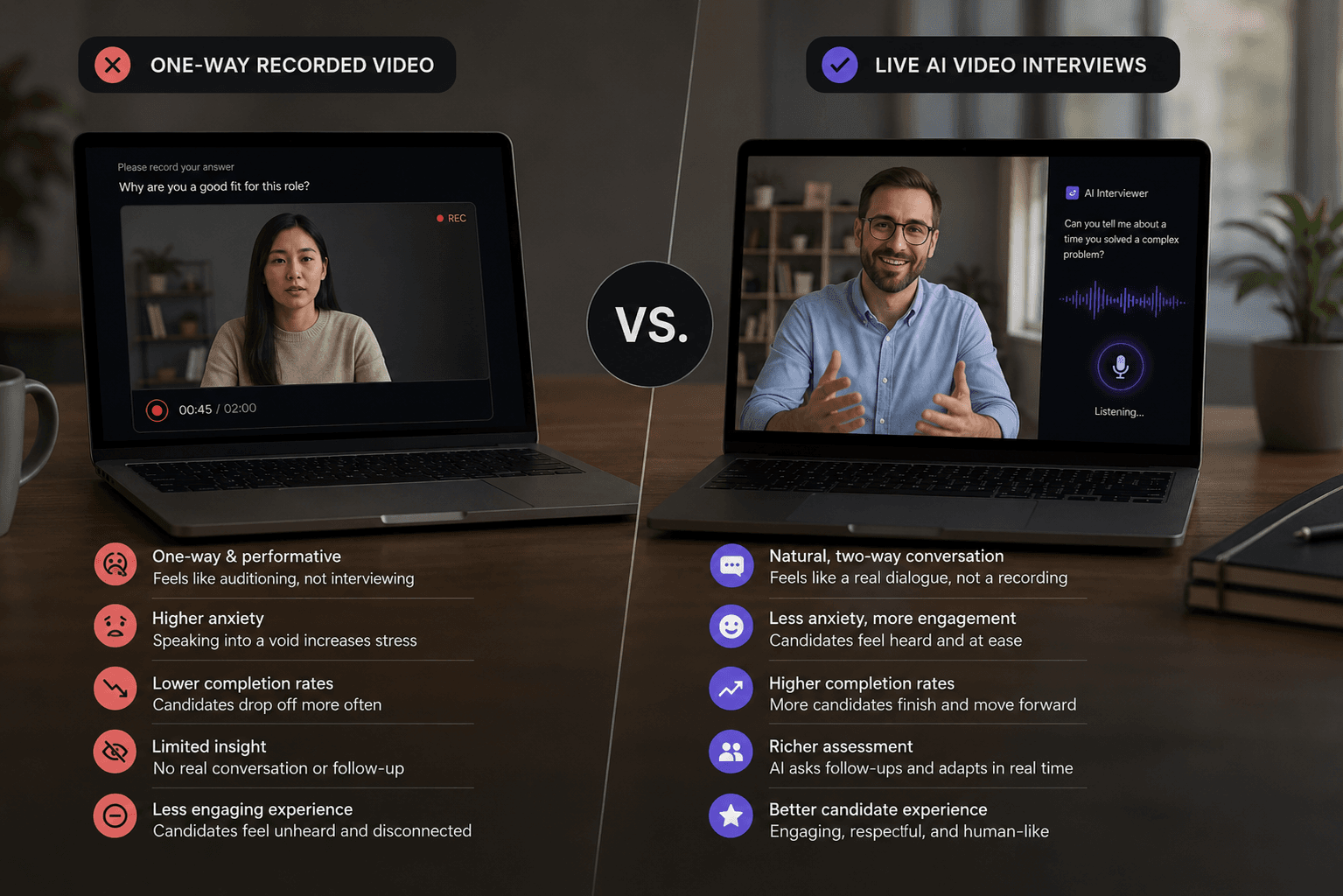
First, the elephant in the room: asynchronous one-way video interviews are universally disliked by candidates. These tools require candidates to stare at a webcam and record responses to text prompts on a screen. There's no real conversation, no feedback, and an unnatural, performative dynamic. Candidates consistently report high levels of anxiety, the feeling that they're speaking into a void, auditioning rather than interviewing.
The anxiety caused by one-way recording directly impacts completion rates. Candidates who feel unheard abandon applications, and the best talent, who have multiple options, is the most likely to walk away. Both conversational voice and live two-way video improve funnel throughput because candidates actually want to engage. One-way recorded video offers neither the accessibility of phone-first screening nor the back-and-forth of a live conversation. It's the worst of both worlds on candidate experience.
From a bias perspective, the meaningful differentiator is structure and rubric, not whether the format is voice or video. AIR's conversational voice interviews are graded against a standardized competency rubric, meaning every candidate is evaluated on the same criteria. The AI evaluates whether the candidate demonstrated the required competencies. That's what makes it fair. See AIR compliance and governance for the human-in-the-loop review model.
Hiring managers get a scorecard and reviewable evidence — not scribbled notes from a rushed phone screen. That evidence pack is what recruiters use to decide who advances.
Frequently Asked Questions
Which AI interview tools conduct real conversational voice interviews instead of one-way recorded video?
Platforms built for live, two-way voice conversations include Braintrust AIR, HeyMilo, Paradox, InterviewFlowAI, and Classet. They run real-time adaptive phone or voice interviews rather than asking candidates to record answers to a fixed prompt list. Braintrust AIR is the conversational voice option with role-specific scoring and ATS-synced rank lists; humans still decide who advances.
Is a live voice interview better than a one-way recorded video interview?
For candidate experience, yes. A real-time conversation with adaptive follow-up questions consistently outperforms one-way recorded video on completion rates and candidate anxiety. The tradeoff versus live video (not versus one-way recording) is signal depth: voice formats don't capture the visual presence and non-verbal communication that a camera can.
Does Braintrust AIR run conversational voice interviews?
Yes. Conversational voice — two-way and adaptive — is AIR's primary interview format. That is the opposite of one-way recorded video, and it is not "live AI video" as the headline format. Try AIR to hear a real interview, or book a demo.
Teams choosing a format should match it to the role: conversational voice for high-volume screening where accessibility and a two-way conversation matter; live video where visual presence is a job-relevant signal; and they should treat one-way recorded video as the weakest candidate-experience option. See AIR, try a demo, or review volume-based pricing.